Understanding the HIV Window Period is important when deciding when to test after a possible exposure. An HIV test cannot detect infection immediately because the body needs time to produce detectable amounts of HIV, antibodies, or antigens. Testing too early can therefore produce a negative result even when infection has occurred. The timing of a test depends on the type of test used, and understanding these differences can help people interpret their results correctly.
It is also important to understand the phrase “100% conclusive.” No HIV test can detect infection immediately after exposure. However, testing after the recommended window period for the specific test provides a highly reliable result. The Centers for Disease Control and Prevention (CDC) explains that different HIV tests have different detection windows.
What Is the HIV Window Period?
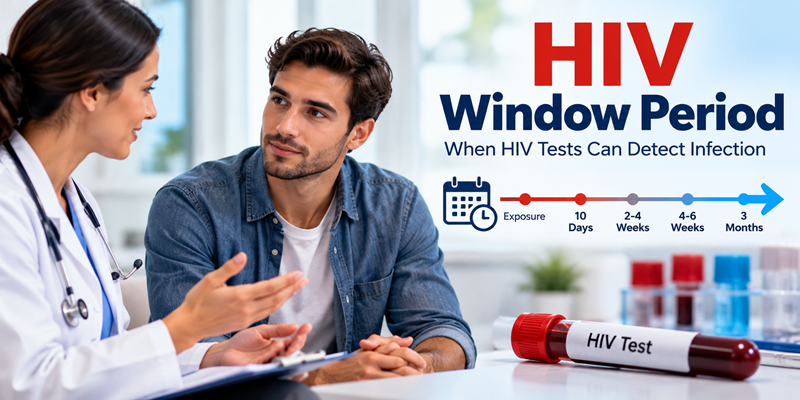
The HIV window period is the time between a potential HIV exposure and the point when a particular test can reliably detect HIV infection. During this period, HIV may already be present in the body, but the markers detected by the test may not yet be present at detectable levels.
This is why a negative HIV test shortly after exposure does not always rule out infection. The result needs to be interpreted according to the test type and the number of days that have passed since the possible exposure.
Why Does the Window Period Matter?
The window period matters because testing too early can lead to a false-negative result. A person may feel completely healthy while infection is developing, so symptoms alone cannot determine whether HIV is present.
Modern HIV tests can detect infection earlier than older tests. However, the exact timing still varies between laboratory antigen/antibody tests, rapid tests, antibody tests, and nucleic acid tests (NATs).
How Long Does Each HIV Test Take to Detect Infection?
There are three major categories of HIV tests: antibody tests, antigen/antibody tests, and nucleic acid tests. Each looks for a different marker of infection.
Antibody HIV Tests
Antibody tests look for antibodies produced by the immune system in response to HIV. Many rapid HIV tests and HIV self-tests are antibody tests.
According to the CDC, antibody tests can usually detect HIV 23 to 90 days after exposure. Because the window can extend to 90 days, a negative result obtained too early may need to be repeated after the appropriate window period.
For people using an HIV self-test, checking the manufacturer’s instructions is especially important because the exact test technology determines its window period.
Fourth-Generation HIV Tests
A fourth-generation laboratory test is an antigen/antibody test. It looks for both HIV antibodies and the p24 antigen, which can appear before antibodies develop.
A laboratory antigen/antibody test using blood drawn from a vein can usually detect HIV 18 to 45 days after exposure, according to the CDC.
The British HIV Association (BHIVA) guidelines state that fourth-generation laboratory tests reliably exclude HIV by 45 days after exposure when the appropriate testing conditions are met.
This makes the laboratory fourth-generation test an important option when someone wants reliable testing after a recent possible exposure.
Rapid Antigen/Antibody Tests
Some rapid tests use blood from a finger stick and detect both antigen and antibodies. Their window period can be longer than that of a laboratory test using blood from a vein.
The CDC states that rapid antigen/antibody tests can usually detect HIV 18 to 90 days after exposure.
Therefore, it is important not to assume that every test marketed as a “4th-generation” or “antigen/antibody” test has exactly the same window period. The sample type and specific test matter.
Nucleic Acid Tests
A nucleic acid test, or NAT, looks for HIV itself rather than antibodies. NATs can detect infection earlier than antibody and antigen/antibody tests.
The CDC reports that a NAT can usually detect HIV 10 to 33 days after exposure. These tests may be considered when there has been a recent possible exposure, particularly when early infection is suspected.
NATs are not normally required for routine HIV screening of everyone. A healthcare professional can determine whether this type of test is appropriate.
When Is an HIV Test Conclusive?
The answer depends on which HIV test was used.
For a laboratory fourth-generation antigen/antibody test using blood from a vein, the CDC gives a detection window of up to 45 days, while BHIVA guidance uses 45 days as the reliable exclusion window for fourth-generation laboratory testing.
For antibody tests and some rapid tests, the window can extend to 90 days. Therefore, someone who tests negative before the end of the relevant window may need another test.
Rather than thinking of one universal “100% conclusive” day for every HIV test, it is more accurate to ask: What type of test was performed, and how long after the possible exposure was it taken?
What If the HIV Test Is Negative During the Window Period?
A negative result during the window period does not necessarily rule out HIV infection. The next step is usually to repeat testing after the appropriate window period for the test used.
For example, a person who receives a negative result shortly after a possible exposure may need another test later. The recommended timing depends on the specific test and individual circumstances.
If the person has taken PrEP or PEP, the situation can be different because antiretroviral medicines can affect how quickly HIV infection becomes detectable. Anyone who has used these medications around the time of a possible exposure should discuss the testing schedule with a healthcare professional.
Does an HIV Test Confirm Infection Immediately?
A positive screening result does not always mean that the initial test alone provides the final diagnosis. Follow-up testing is used to confirm a positive result.
If an HIV self-test or community-based antibody test is positive, the CDC recommends follow-up testing through a healthcare provider. When a laboratory screening test is positive, additional testing is generally performed to confirm the result.
This confirmation process is important because HIV diagnosis follows established testing algorithms rather than relying on one preliminary result.
What Should You Do After a Possible HIV Exposure?
If you believe you may have been exposed to HIV recently, do not rely only on symptoms or on a test taken too early. Consider speaking with a healthcare professional about the appropriate test and testing schedule.
If the exposure occurred within the previous 72 hours, urgent medical advice is particularly important because post-exposure prophylaxis (PEP) may be an option for some people. PEP works best when started as soon as possible.
Regular testing can also be part of HIV Prevention and Testing, particularly for people who may have ongoing exposure risks.
Understanding Your HIV Test Result
A negative result is reassuring when the test has been taken after the appropriate window period, and there have been no later exposures. A negative test taken too early, however, may not provide the same level of reassurance.
A positive screening result should be followed by confirmatory testing rather than being interpreted alone. If you are uncertain about the test type, the date of exposure, or the meaning of the result, a healthcare professional can help you understand what your result means.
The most important point is that HIV testing accuracy depends on both the technology used and the timing of the test.
Frequently Asked Questions
Is an HIV test 100% conclusive?
No test should be described as immediately 100% conclusive after exposure. The reliability of a negative result depends on the test used and whether enough time has passed for that test to detect infection. Following the recommended window period provides a highly reliable result.
Is 45 days enough for a fourth-generation HIV test?
For a laboratory fourth-generation antigen/antibody test using blood from a vein, the CDC gives a window period of 18 to 45 days, and BHIVA guidelines use 45 days as the reliable exclusion window.
Is 90 days enough for an antibody HIV test?
The CDC states that antibody tests can usually detect HIV 23 to 90 days after exposure. Therefore, 90 days is the outer end of the stated window for antibody testing.
Can I test positive during the window period?
Yes. Some tests can detect HIV relatively early, especially NATs and laboratory antigen/antibody tests. However, a negative result during the window period cannot necessarily exclude infection.
Should I repeat an HIV test after a negative result?
If you tested during the window period, repeat testing after the relevant window period for your test is recommended. The CDC specifically advises repeat testing after the window period when a person has tested negative following a possible exposure.
Can symptoms tell me whether I have HIV?
Symptoms cannot reliably determine whether someone has HIV. Some people experience early symptoms, while others have no noticeable symptoms. Testing is the appropriate way to determine HIV status.
What is the earliest HIV test?
A NAT can usually detect HIV approximately 10 to 33 days after exposure, making it one of the earliest available testing methods. However, it is not routinely required for everyone and should be discussed with a healthcare professional.
Final Thoughts
Understanding the HIV window period can prevent unnecessary confusion about test results. There is no single testing day that applies to every HIV test. Laboratory fourth-generation tests, rapid antigen/antibody tests, antibody tests, and NATs all have different detection windows. For HIV Testing After Exposure, the safest approach is to identify the test used, count the time from the possible exposure, and follow the recommended testing window.
A negative result taken after the appropriate window period is highly reassuring, while an early negative result may need to be repeated. If you have concerns about a recent exposure, PEP, PrEP, or your testing schedule, speak with a qualified healthcare professional.